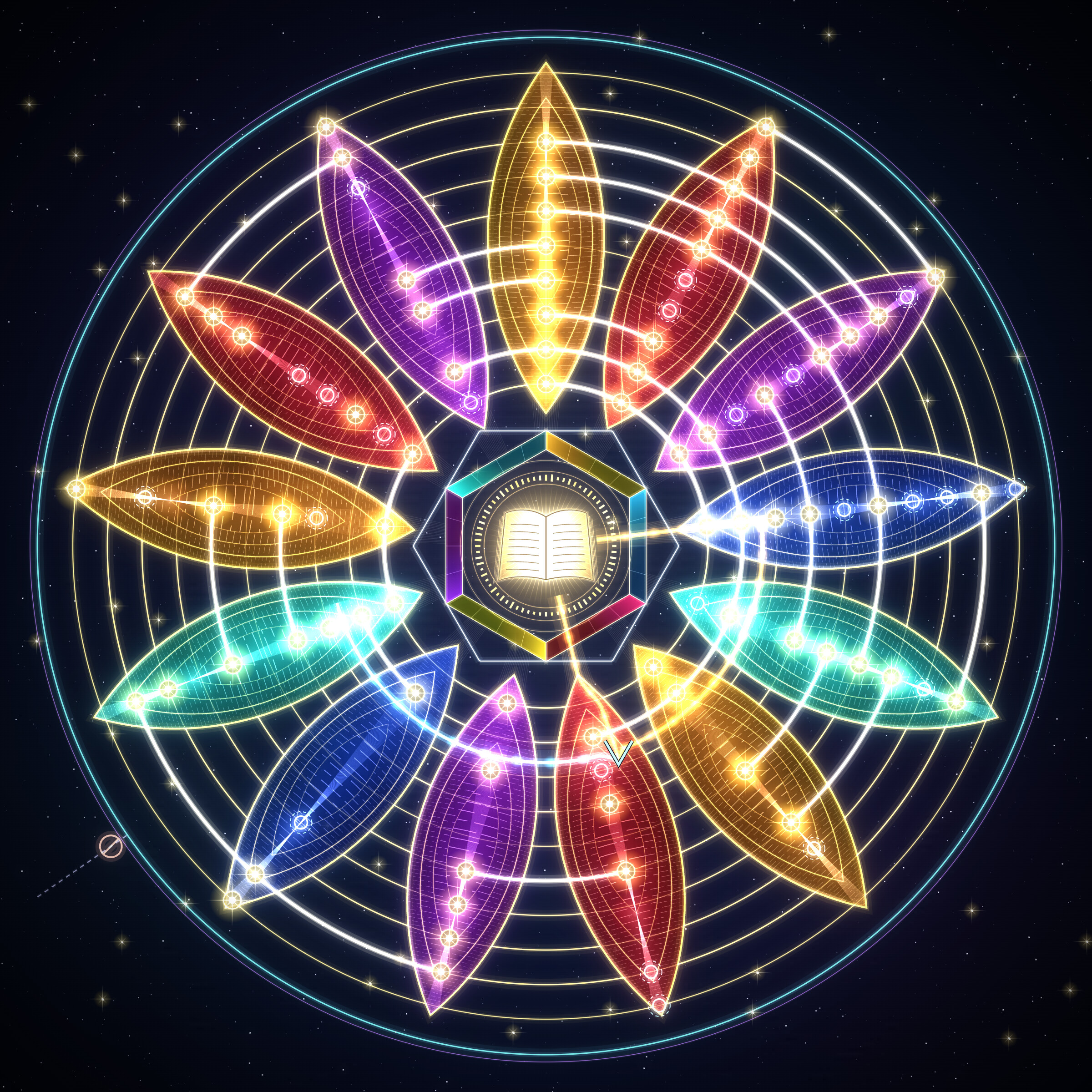
Construction definitions
The drawing uses a 2400 × 2400 coordinate square. Ring radii are measured from its centre: r₀ is 356 units and Δr is 76 units. These are drawing coordinates, not physical distances.
The supplied Atlas has 13 lenses and 10 structures: 130 cells, comprising 72 S grades, 23 X grades and 35 ungraded cells. Here g(i, j) is the supplied grade, nS(j) counts S grades on ring j, and nX(j) counts X grades on that ring. The encoding places 95 nodes and 36 glowing arcs, including 3 arcs across the last-to-first lens boundary.
The drawing counts each S as one and each X as one half, then divides each ring’s total by the largest total, 10.5 for Relation, to obtain its normalized construction weight. The half-weight is an artistic choice. These weights guide width and light; they are not visible-width percentages or confidence scores.
A glowing arc records two neighbouring S grades on the same ring, with lens indices wrapping modulo 13. Encoding the supplied table does not prove disciplinary equivalence. The thread and painted V illustrate the framework; they do not execute a transition or validation.
The picture as text
At the centre, an open book (one physical copy) inside a ring of type (its edition) and a halo (the work). Around it, six coloured facets for the library’s state (objects, relations, epistemic records, methods, history, reader authority), and a brighter hexagon for the next state.
Thirteen lenses, one per field, clockwise from the top; in each, the book’s lines at four scales: Mathematics & theoretical computer science; Psychology & cognitive science; Epistemology & philosophy of science; Hermeneutics & literary theory; Library & information science; Complex systems; Phenomenology; Learning science; Philosophy of mind; Semiotics; Historiography; Cybernetics; Ethics & philosophy of technology. Ten rings, one per structure, from the centre outward: Transformation, Relation, Recursion, Invariance, Emergence, Provenance, Feedback, Higher order, Agency, Humility; their normalized construction weights, in the same order, as percentages of the largest weight (not visual widths or confidence scores): 95%, 100%, 71%, 86%, 57%, 86%, 76%, 81%, 86%, 57%. A ring glows between two neighbouring lenses where both are S on it (36 places).
The Atlas marks, lens by lens (72 S, 23 X; nothing elsewhere):
- Mathematics & theoretical computer science: S at Transformation, Relation, Recursion, Invariance, Emergence, Provenance, Feedback, Higher order; X at none.
- Psychology & cognitive science: S at Transformation, Relation, Recursion, Provenance, Feedback, Higher order, Agency, Humility; X at Invariance, Emergence.
- Epistemology & philosophy of science: S at Transformation, Relation, Invariance, Provenance, Feedback, Higher order, Humility; X at Recursion, Emergence, Agency.
- Hermeneutics & literary theory: S at Transformation, Relation, Recursion, Invariance, Provenance, Agency; X at Emergence, Feedback, Higher order, Humility.
- Library & information science: S at Relation, Invariance, Emergence, Provenance, Feedback, Agency; X at Transformation, Higher order.
- Complex systems: S at Transformation, Relation, Emergence, Feedback; X at Higher order.
- Phenomenology: S at Relation, Invariance, Provenance; X at Recursion, Agency, Humility.
- Learning science: S at Transformation, Recursion, Provenance, Feedback, Higher order, Agency; X at none.
- Philosophy of mind: S at Relation, Agency, Humility; X at Feedback.
- Semiotics: S at Transformation, Relation, Recursion, Invariance, Provenance, Higher order, Agency; X at none.
- Historiography: S at Transformation, Invariance, Provenance, Humility; X at Recursion, Higher order.
- Cybernetics: S at Transformation, Recursion, Feedback, Higher order, Agency; X at Relation, Invariance, Emergence.
- Ethics & philosophy of technology: S at Relation, Invariance, Emergence, Agency, Humility; X at Transformation, Higher order.
The thread leaves the book along Hermeneutics & literary theory, runs around the Relation ring through the next lenses to Phenomenology, where the gate stands, and returns to the book. The cyan filament starts at the gate and runs part of the way around, between the Relation ring and the next. A dashed line from outside, between two petals at the lower left, ends at the membrane with ⊘: a refused input.